Showing posts with label mountain. Show all posts

Tuesday, 5 July 2011

America's Most Beautiful Landmarks

From soaring man-made monuments to jaw-dropping natural landforms, the U.S. has a wealth of beautiful landmarks.


Niagara Falls, New York .


While the Eiffel Tower, the Taj Mahal, and Mount Fuji may be the first images that come to mind when we picture beautiful landmarks, the truth is that there are numerous dazzling sights—both natural and man-made—right here in the United States.

The past century-and-a-half has seen the creation of two organizations that work together to protect America’s national treasures. After the first national park, Yellowstone, was established in 1872 to protect the natural beauty of its world-famous geyser basins and wildlife, the U.S. National Park Service was founded in 1916—and now oversees the preservation of 58 parks around the country. Later, the National Historic Preservation Act of 1966 created the National Register of Historic Places, to protect landmarks that specifically illustrate the heritage of the United States.

Not all of the landmarks on our list have been officially designated as state parks or National Historic Places. And, on their surface, many of them may seem dissimilar: one is an extraordinary (and still active) volcano, while another is a lighthouse; one is a mighty waterfall, while another is a centuries-old desert adobe settlement. But what’s amazing is that these landmarks, disparate though they are, share a home right here on U.S. soil. And all of them have played a part, however small, in our national history.

Niagara Falls, New York


More than 750,000 gallons of water per second thunder down this iconic 167-foot waterfall—the most powerful on the North American continent. The falls straddle the border between the U.S. and Canada, and though some argue that Horseshoe Falls—set on the Ontario side—is more spectacular than the smaller American Falls, the landmark has held a particular place in American history ever since 1901, when Michigan schoolteacher Annie Edson Taylor was the first person to go over the falls (and survive) in a barrel.

How to See It: Take a half-hour water tour on the Maid of the Mist ferry, which has boarding docks in both countries.

Mount Rushmore National Memorial, Keystone, South Dakota


Carved into a granite mountain face in South Dakota’s southwesterly Black Hills, this sculpture of four of America’s most influential presidents (Washington, Jefferson, Lincoln, and Theodore Roosevelt) was considered an extraordinary feat of engineering when it was completed in 1941—and it’s still majestic today, bringing in more than two million visitors per year.

How to See It: If you visit in winter, you’ll be able to avoid the summer crowds and see the monument dusted with snow. In warmer months, though, try to catch the evening lighting ceremony (starting at 9 p.m.), where park rangers slowly illuminate the enormous granite faces above.

Golden Gate Bridge, San Francisco


Stretching 1.7 miles high above the mist-enshrouded waters of San Francisco Bay, this peaked, vermilion-painted suspension bridge (the color is officially known as International Orange) is as striking today as it was when it was completed in 1937. The natural surroundings—including the coves and forested bluffs of Marin County; the island of Alcatraz; and numerous sailboats, barges, kite-surfers, and even frolicking seals—can all be seen from the bridge on a clear day.

How to See It: Walking at least partway along the bridge’s pedestrian path allows for the most dramatic views (and best photo ops).

The Wave, Coyote Buttes, Arizona


Set in the remote Paria Canyon-Vermilion Cliffs Wilderness in northern Arizona, this dazzling rock formation, which looks like a cresting wave frozen in time, isn’t easy to access: you’ll need a permit from the Bureau of Land Management, which allows only 20 people per day to visit the delicate landform. But getting to see this fiery swirl of Jurassic-age sandstone, carved by the wind more than 190 million years ago, is well worth a little advance planning.

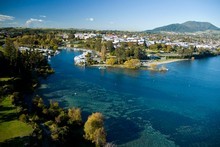
Central New Zealand shaken by strong quake


A magnitude-6.5 earthquake struck near Taupo this afternoon and was felt widely throughout the country. File photo / NZ Herald

A magnitude-6.5 earthquake struck near Taupo this afternoon and was felt widely throughout the country. File photo / NZ Herald


 A deep seated earthquake measuring magnitude 6.5 struck central New Zealand on Tuesday, but there were no reports of damage or injuries.

The Institute of Geological and Nuclear Sciences said the tremor of magnitude 6.5 struck at 3.36 p.m. (0336 GMT).

The government institute said it was centred 30 kms (18 miles) east of the holiday town of Taupo, close to the volcanically active area of Mount Ruapehu.

The quake was 150 km below ground level.

New Zealand scientists record around 14,000 earthquakes a year, of which on average around 20 top magnitude 5.0.

The country has been more alert to earthquakes since the South Island city of Christchurch, was struck by two devastating quakes in September last year and in February this year. The latter killed 181 people and caused an estimated NZ$15 billion of damage. 


The Prime Minister's press secretary, Lesley Hamilton, said the quake was felt strongly on the ninth floor of the Beehive.
Briar Charmley, private secretary for the Attorney-General on the 19th floor of Bowen House in downtown Wellington, said the building swayed more than in any previous earthquake she had felt in her 12 months in the office. 

Others compared the quake given to the 2.9 magnitude shock that struck Auckland on Friday.
"Aucklanders make a big deal over a 2.9 that felt like a gust of wind all over the news. Wellingtonians brush off a 6.5," Keegan Check said.


Thursday, 16 June 2011

Libyan rebels take new villages in Western Mountains


Rebel fighters are seen before a heavy fight against pro-Gadhafi forces at the frontline of Dafneya, some 40 km west Misrata, Libya, Sunday, June 12, 2011. (AP Photo/Hassan Ammar)
Rebel fighters are seen before a heavy fight against pro-Gadhafi forces at the frontline of Dafneya, some 40 km west Misrata, Libya, Sunday, June 12, 2011.


Libyan rebels have pushed deeper into government-held territory from their base in the Western Mountains, taking two villages from which forces loyal to Muammar Gaddafi had been shelling rebel-held towns.

But the rebels are still a considerable way from Gaddafi's main stronghold in Tripoli, while their fellow fighters on the other two fronts -- in Misrata and in eastern Libya -- have made only halting progress against better-armed government troops.

The rebel advance some 150 km (90 miles) southwest of Tripoli on Wednesday, came as the White House insisted that President Barack Obama had the legal authority to press on with US military involvement in Libya.

Strains have begun to show in the Western alliance trying to topple Gaddafi. The US defense secretary rounded on European allies last week for failing to back the mission the alliance took over in late March.

The White House urged skeptical lawmakers not to send "mixed messages" about their commitment to the NATO-led air war that has helped the rebels push on from their bastion in the east.

"The revolutionaries (rebels) now control Zawiyat al-Babour and al-Awiniyah after pro-Gaddafi forces retreated this morning from the two villages," Abdulrahman, a rebel spokesman in the nearby town of Zintan.

In Gharyan, a Gaddafi-held town that forms the gateway from Tripoli to the mountains, there was an undercurrent of tension as the frontline moves closer to the capital.

Libyan government minders took a group of reporters to the town, which lies about 120 km southwest of Tripoli and about 20 km east of Kikla, which rebels seized from loyalists on Tuesday.

Despite an outward appearance of normality, walls around town on Wednesday had recently painted over graffiti. The windows of one government building were smashed, the sign for another was riddled with holes.

While many traders and people on the streets were reluctant to talk to reporters, one shop owner said the calm in the area during the day was replaced by fighting every night.

"Two thirds of the people here are for the rebels," he told Reuters, giving his name as Mohammed.

Those willing to talk in front of the minders were strongly pro-Gaddafi.

"Sarkozy is stupid, he is fighting this war for petrol," a man called Yunis said in French, referring to the French president, vilified by Gaddafi supporters as the driving force behind NATO bombing. "This is colonialism all over again."

Twitter Delicious Facebook Digg Stumbleupon Favorites More