Showing posts with label gmt. Show all posts

Thursday, 7 July 2011

Tempest-from-hell seen on Saturn


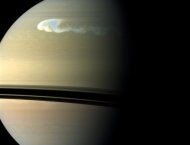
Photo provided by NASA shows an image of Saturn taken in 2010 by the Cassini camera, showing a storm with a latitudinal and longitudinal extent of 10,000 km and 17,000 km, respectively. Imagine being caught in a thunderstorm as wide as the Earth with discharges of lightning 10,000 times more powerful than normal, flashing 10 times per second at its peak

 
shows an image of Saturn taken in 2010 by the Cassini camera, …


Imagine being caught in a thunderstorm as wide as the Earth with discharges of lightning 10,000 times more powerful than normal, flashing 10 times per second at its peak.


Now imagine that this storm is still unfolding, eight months later.

One of the most violent weather events in the Solar System began to erupt on Saturn last December and is still enthralling astronomers.

Two studies draw on observations by professional and amateur astronomers using a broad range of gear, from relatively small ground-based telescopes to NASA's magnificent scoutcraft, Cassini.

Saturn, like Jupiter, is no stranger to convective storms.

It too is a "gas giant," or planet comprising layers of thick, roiling gases rather than a rock, like Earth, Mars, Venus and Mercury.

The difference, though, is that jovian mega-storms tend to erupt unexpectedly, but the lord of the rings gives birth to a monster almost periodically.

It occurs on average once every Saturnian year -- nearly 29.5 Earth years -- and appears to be linked to the summer solstice, when the planet's orbit brings it a bit closer to the Sun and its atmosphere warms a little.

The event is known as the "Great White Spot" (a counterpart to the swirling "Great Red Spot" on Jupiter) because of the mass of brilliant white storm clouds that erupt in the upper atmosphere.

The show is so big that it can be visible by telescopes from distant Earth. Five have been observed in the last 130 years. The last occurred in 1990.

But the current Great White Spot is proving to be a dazzling spectacle, revealed by an unprecedented array of observational power at hand.

Events began at 2105 GMT on December 5, when ground-based telescopes detected a "barely visible white point" on a normally unblemished and hazy part of Saturn's northern hemisphere, at around latitude 35 degrees north.
At the same time, Cassini turned its "ears" towards the target, listening in to radio emissions from the storm via an onboard plasma-wave instrument.
These signals are the telltales of lightning. Lightning cannot be seen visually on Saturn at night because of interference from sunlight scattered from the planet's ring system, which comprises billions of shiny particles.
Within a few weeks, the point had ballooned into a storm system that was some 10,000 kilometers (6,000 miles) across, roughly comparable with the diameter of the Earth, and after two months the clouds had almost encircled the entire planet.
Analysis of the data suggests that the "spot" is in fact a cluster of super-storms, produced by upwelling of heat, moisture and ammonia from water clouds from lower down in the Saturnian atmosphere, where the pressure is high.

As this mix rises into a cooler atmospheric layer called the tropopause, bright, white clouds of ammonia start to spread horizontally into a tail, sculpted by eastward jets of wind.

Astronomers are especially intrigued by the current Great White Spot.

The observational history of this phenomenon is sketchy. But evidence suggests the present spot is exceptionally intense and rather premature, for it was still spring on Saturn when the storm brewed.

Tuesday, 5 July 2011

Central New Zealand shaken by strong quake


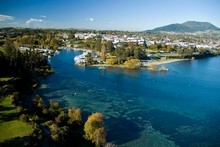
A magnitude-6.5 earthquake struck near Taupo this afternoon and was felt widely throughout the country. File photo / NZ Herald

A magnitude-6.5 earthquake struck near Taupo this afternoon and was felt widely throughout the country. File photo / NZ Herald


 A deep seated earthquake measuring magnitude 6.5 struck central New Zealand on Tuesday, but there were no reports of damage or injuries.

The Institute of Geological and Nuclear Sciences said the tremor of magnitude 6.5 struck at 3.36 p.m. (0336 GMT).

The government institute said it was centred 30 kms (18 miles) east of the holiday town of Taupo, close to the volcanically active area of Mount Ruapehu.

The quake was 150 km below ground level.

New Zealand scientists record around 14,000 earthquakes a year, of which on average around 20 top magnitude 5.0.

The country has been more alert to earthquakes since the South Island city of Christchurch, was struck by two devastating quakes in September last year and in February this year. The latter killed 181 people and caused an estimated NZ$15 billion of damage. 


The Prime Minister's press secretary, Lesley Hamilton, said the quake was felt strongly on the ninth floor of the Beehive.
Briar Charmley, private secretary for the Attorney-General on the 19th floor of Bowen House in downtown Wellington, said the building swayed more than in any previous earthquake she had felt in her 12 months in the office. 

Others compared the quake given to the 2.9 magnitude shock that struck Auckland on Friday.
"Aucklanders make a big deal over a 2.9 that felt like a gust of wind all over the news. Wellingtonians brush off a 6.5," Keegan Check said.


Sunday, 12 June 2011

Powerful quakes rattle New Zealand city, six injured


Lightning flashes around the ash plume at above the Puyehue-Cordon Caulle volcano chain near Entrelagos June 5, 2011. The volcano in the Puyehue-Cordon Caulle chain, dormant for decades, erupted in south-central Chile on Saturday, belching ash over 6 miles (10 km) into the sky, as winds fanned it toward neighboring Argentina, and prompted the government to evacuate several thousand residents, authorities said. REUTERS/Carlos Gutierrez


  A series of powerful tremors rattled the quake-prone New Zealand city of Christchurch Monday, destroying a building and sending boulders tumbling down hillsides.

Six people suffered minor injuries.

New Zealand's GNS Institute put the strongest of the quakes at a magnitude of 6.0 at 2.20 pm (10:20 pm ET). The United States

Geological Survey also pegged it at 6.0 -- with the epicentre four miles east south east of the city at a depth of 5.6 miles.

Four tremors above 4.3 were recorded from 0029 GMT.

Shopping malls and office buildings were evacuated across the city, which is still trying to recover almost four months after a magnitude 6.3 earthquake killed 181 people and caused extensive damage.

A building in the city center collapsed and minor damage occurred in buildings affected in previous earthquakes, Christchurch Police spokesman Steven Hill told.

"The building has been checked and been given the all-clear," Hill said, meaning no one was trapped inside.

The St John ambulance service said six people had been taken to hospital with moderately serious injuries, all caused by falling building materials.

As with the initial quake, Monday's aftershock sent boulders on the city's Port Hills tumbling toward houses. Parts of the eastern city, which suffered the most damage in February's tremor, suffered from flooding and liquefaction - where solid ground is turned into liquid by the force of the quake.

Power was cut to about 10,000 houses.

Christchurch has experienced a number of strong earthquakes since a magnitude 7.1 quake struck the city on Sept 4 last year.

Parts of the central city have been closed to the public since the Feb 22 quake, and one of the city's tallest buildings, the Grand Chancellor Hotel, has been declared unstable and is being prepared for demolition.


Twitter Delicious Facebook Digg Stumbleupon Favorites More