Showing posts with label power. Show all posts

Monday, 20 June 2011

UN atom chief urges nuclear stress tests, inspections


The UN nuclear chief called on Monday for national safety tests on all the world's reactors within 18 months, followed by international inspections to help prevent any repeat of Japan's atomic crisis three months ago.

Yukiya Amano, opening a ministerial meeting in Vienna on strengthening safety standards after the Fukushima emergency, said UN experts should be allowed to carry out random safety reviews of nuclear power plants.

His proposals -- aimed at ensuring that nuclear plants can withstand extreme events such as the earthquake and tsunami that crippled Fukushima -- may prove controversial for states which want to keep safety an issue strictly for national authorities.

"Public confidence in the safety of nuclear power has been badly shaken," Amano, director general of the International Atomic Energy (IAEA), said in a speech to ministers and regulators from the UN body's 151 member states.

"However, nuclear power will remain important for many countries, so it is imperative that the most stringent safety measures are implemented everywhere."

Amano, a veteran Japanese diplomat, said nuclear safety would remain a national responsibility -- and that governments would have the main task of testing, if only in theory, whether reactor systems could withstand various stresses. But he also made clear he wanted the U.N. agency to play a greater role.

"IAEA review of every one of the world's 440 operating nuclear reactors in just a few years is not a realistic proposition. I therefore propose a system based on random selection," he said.

Japan's crisis has prompted a rethink of energy policy around the world, underlined by Germany's decision to shut down all its reactors by 2022 and an Italian vote to ban nuclear power for decades.

At the June 20-24 meeting, IAEA member nations will begin charting a strategy on boosting global nuclear safety, but differences on how much international action is needed may hamper follow-up efforts, diplomats say.

Russia wants to move towards making the UN agency's safety standards compulsory, but many other countries oppose this.

EXTREME NATURAL HAZARDS

Currently there are no mandatory, international nuclear safety regulations, only IAEA recommendations which national regulators are in charge of enforcing.

Russia's atomic energy chief Sergei Kiriyenko welcomed Amano's proposals, telling the conference that "we are delighted that they are very much in keeping" with Moscow's views.

Japanese officials have come under fire for their handling of the emergency and the authorities have admitted that lax standards and poor oversight contributed to the accident.

Three reactors at the Japanese complex went into meltdown when power and cooling functions failed, causing radiation leakage and forcing the evacuation of some 80,000 people.

"In the light of the Fukushima Daiichi accident, thorough and transparent national risk assessments should be made of all nuclear power plants in the world.

"They should focus on safety margins against extreme natural hazards, such as earthquakes, tsunamis and floods. This could be done within 12 to 18 months."

He gave no details of how such assessments would be carried out. Typically experts speak of "stress tests" which provide for theoretical and practical simulations of how power plant systems would respond to various "stress" events, such as earthquakes.

Amano said these national assessments should be followed by IAEA expert reviews to check operational safety emergency preparedness, and the effectiveness of regulatory systems.

"I propose that countries with nuclear power should agree to systematic, periodic peer reviews by the IAEA," he said.

"The agency could conduct an international safety review of one nuclear power plant in 10 throughout the world over, say, a three-year period."

Thousands protest in Morocco for more reform


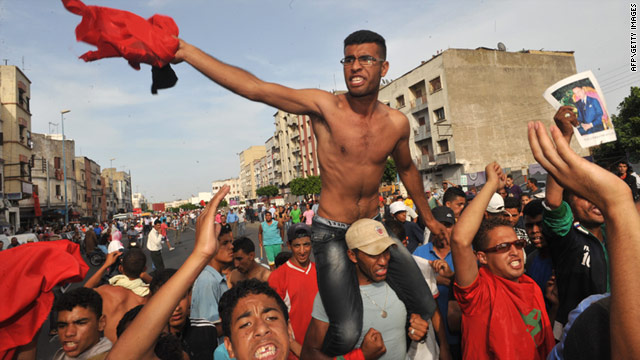
Pro-constitution Moroccans try to block a protest on Sunday in Casablanca called by the country's youth movement. 
 
  Several thousand people marched through Morocco's biggest city Sunday to protest that constitutional reforms unveiled this week by King Mohammed have not gone far enough.

After some of the biggest protests in decades -- inspired in part by the "Arab Spring" uprisings -- the monarch announced on Friday he would devolve some of his powers to parliament and the government and put the reforms to a referendum on July 1.

Under the changes, the king would retain his hold on security, the army and religion. That disappointed some opponents who had wanted to see the monarch hand over all his executive powers to elected officials.

"We are here to reject the proposed constitution," said Aziz Yaakoubi, one of the organisers of Sunday's protest in Casablanca, Morocco's commercial capital.

"It keeps all the powers in the hands of the king. He refused to listen to the street."

Protesters marched through Casablanca's working class Derb Sultan district carrying placards that read: "No to a constitution made for slaves!" and "No to a constitution of dictatorship!"

About 10,000 people took part in the protest, according to a Reuters reporter at the event, while about 500 pro-monarchy activists gathered for a nearby counter-demonstration.

Organisers of the opposition demonstration said 20,000 people took part.

A government official, who did not want to be identified, said 2,500 people took part in the opposition protest and that most of them were members of a banned Islamist group. The official also said the pro-monarchy counter-protest was attended by 70,000 people.

Most Moroccans revere the monarch and months of protests demanding he give up his executive powers have failed to win the sort of popular support that toppled long-standing leaders earlier this year in Tunisia and Egypt.

The moves by King Mohammed, who heads the Arab world's longest-serving dynasty, are being closely monitored by Gulf Arab monarchies which are also facing calls for reform.

Before the march got underway, several dozen young men carrying the Moroccan flag, sticks and broken bottles charged the protesters. Activists blocked their way and the confrontation was defused.

There was a light police presence and the march ended without any violence.

The referendum is likely to endorse the monarch's reforms. Some people at Sunday's protest, organised by the February 20 opposition movement, called for a boycott of the vote.

Some of the demonstrators chanted: "Moroccans, the referendum is a charade!" and "We are not voting for a constitution we don't agree to!"

"The king introduced cosmetic changes that actually strengthen his grip over the decision-making process," said Abderrahim Tafnout of the Unified Socialist Party, which has two seats in parliament.

There were also protests organised by the February 20 movement Sunday in other cities including Tangier and Rabat, but figures on how many people took part were not immediately available.


Tuesday, 14 June 2011

Former Tunisian president to face June 20 trial

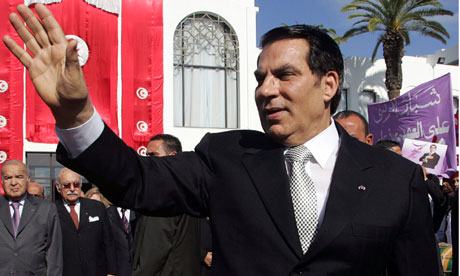
 Former Tunisian president Zine al-Abidine Ben Ali, who fled to Saudi Arabia in January, will be tried in absentia on June 20, Tunisia's interim prime minister said Monday. 


    Former Tunisian president Zine al-Abidine Ben Ali


"Ben Ali's trial will start on June 20," Beji Caid Sebsi said in an interview on Al Jazeera television. "He will be tried in a military and in a civilian court." 


Ben Ali fled to Jeddah after he was toppled by mass protests on January 14 after 23 years in power. Several members of his family and security and some of his closest allies were detained shortly after he was forced out. 


Tunisian authorities have been preparing several legal cases against Ben Ali, including conspiring against the state, voluntary manslaughter and drug trafficking. 


The caretaker authorities, trying to assert their authority and gain legitimacy in the eyes of protesters who forced the transition, are attacking the vestiges of his long rule. 


Saudi authorities have not responded to a request by Tunis to extradite Ben Ali and his wife Leila Trabelsi. 


Former Egyptian President Hosni Mubarak, who was ousted shortly after Ben Ali, is also due to stand trial for the killing of protesters and could face the death penalty.

Sunday, 12 June 2011

Fighting in Zawiyah shuts Libya road to Tunisia


Libyan troops loyal to Muammar Gaddafi fought gun battles with rebels in the town of Zawiyah Saturday, witnesses said, shutting the coastal highway that links the capital Tripoli with Tunisia.


 the highway was deserted except for lots of soldiers, police and armed men in civilian clothes. One heard bursts of gunfire coming from the direction of the city.

"The situation is very bad in Zawiyah. There's been fierce fighting since the morning," said the resident, who gave only his first name, Mohammed, fearing reprisals.

Four months since Gaddafi's forces crushed a popular uprising against his four-decade rule that then morphed into an armed rebellion, Libya's civil war is in stalemate.

Nearly three months of bombings by NATO war planes against Libyan military targets have failed to unseat Gaddafi or enable the rebels to launch an offensive on his territory in Tripoli.

Several explosions were heard in Tripoli throughout the afternoon, as late as 8 p.m. (2 pm ET), suggesting NATO was ramping up attacks after a quiet morning.


Rebel spokesman Ahmed Bani said a senior Gaddafi aide had been wounded in a NATO strike on a city close to Tripoli on Saturday evening and was in hospital. There was no independent confirmation and Libyan officials were not available to comment.

ENCIRLE

The rebels control the east of Libya, the western city of Misrata and the range of mountains near the border with Tunisia. They are seeking to encircle the capital and cut it off, an aim that would be advanced if they manage to capture Zawiyah.

The highway has been used throughout the conflict by Gaddafi's officials -- including fleeing defectors -- to reach the outside world, and by trucks bringing in food and other supplies to territory under Gaddafi's control.

After a lull in fighting in the western, rebel-held city of Misrata, pro-Gaddafi forces which have besieging it started shelling its port late Saturday, Al Jazeera TV reported.

A doctor at the Hekma hospital said 31 people were killed and 110 wounded in shelling by Gaddafi forces Friday.

Pro-Gaddafi troops encircled the city of Zlitan, 160 km east of Tripoli, Saturday, rebels said, after fighting broke out there that could also open up the coastal road to the capital.

Some clashes between Gaddafi's forces and rebels continued in the city, rebel spokesman Bani said, after the rebels took some parts of it. The toll remained 22 rebels killed.

Government spokesman Moussa Ibrahim played down the clashes.

"There is no serious fighting going on in Zawiya or Zlitan. What has happened is that we've had small groups of rebels who have made their way from Zintan and the Western Mountains to cause trouble in these areas,"

Zlitan is one of three towns that are largely government controlled between the rebel-held Misrata and the capital. Were it to fall, it could allow the anti-Gaddafi uprising to spread from Misrata, the biggest rebel outpost in western Libya, to Gaddafi's stronghold in Tripoli.

DIPLOMACY FALTERS, FIGHTING INCREASES

World powers have given mixed signals on how the war might play out, with Russia trying to mediate reconciliation. Turkish Prime Minister Tayyip Erdogan said Friday he had offered a "guarantee" to Gaddafi if he left Libya, but received no reply.

Gaddafi has refused to step down, describing the rebels as al Qaeda terrorists and Western intervention as an oil grab.

As diplomacy falters, several new battle fronts have opened.

Gaddafi's forces also shelled for the first time the UNESCO world heritage-listed city of Ghadames, 600 km (370 miles) southwest of Tripoli, on the Tunisia and Algeria borders, overnight, opening a new front in the war, rebels said.

Rebels said the oasis town, with a population of about 7,000 people, mainly Berber, was under attack after an anti-government protest in the old Roman city Wednesday.

"This is a retaliation for anti-regime protests," spokesman Juma Ibrahim said from the rebel-held town of Zintan.

The report could not be independently verified.

The old town was de-populated by Gaddafi in the 1990s and its inhabitants moved into modern buildings. It was not clear if the attack hit the old town, a labyrinth of narrow, underground passages and houses known as the "Pearl of the Desert."

US Defense Secretary Robert Gates said Friday some NATO allies of failing to pull their weight:


Saturday, 11 June 2011

SYRIA UNREST Copters open fire to disperse protesters


  Syrian helicopter gunships fired machineguns to disperse pro-democracy protests, witnesses said, in the first reported use of air power to quell unrest in Syria's increasingly bloody three-month-old uprising.

The use of the aircraft came on a day of nationwide rallies against President Bashar al-Assad, as unrest showed no sign of abating despite the harsh crackdown by his authoritarian state.


The helicopters opened fire in a northwestern town after security forces on the ground killed five protesters, said the Syrian Observatory for Human Rights.


"At least five helicopters flew over Maarat al-Numaan and began firing their machineguns to disperse the tens of thousands who marched in the protest," one witness said by telephone.


"People hid in fields, under bridges and in their houses, but the firing continued on the mostly empty streets for hours," said the witness, who gave his name as Nawaf.


Syria's state television, in contrast, blamed violence in the area on anti-government groups. It made no mention of attack helicopters but said an ambulance helicopter had come under fire over Maarat from "terrorist armed groups," injuring crew.


Britain, France, Germany and Portugal have asked the U.N. Security Council to condemn Assad, though veto-wielding Russia has said it would oppose such a move.


Denouncing the Syrian government's actions, the White House said Friday's "appalling violence" had led the United States to back the European draft resolution at the United Nations. "The Syrian government is leading Syria on a dangerous path," the White House said.


Foreign Minister Walid al-Moualem wrote to the Security Council accusing the opposition of violence and sabotage, Al Arabiya television said. Foreign governments were basing their views on "inaccurate information," it said.


State television said earlier well-armed "terrorist groups" had burned police buildings and killed members of the security forces in Maarat al-Numaan, which lies 55 km (35 miles) south of Syria's second city Aleppo on the highway to Damascus.


LETTER ASKING FOR HELP


Moualem's letter asked for UN help to combat "extremism and terrorism." Damascus wanted dialogue with the opposition, the letter said.


Syrian authorities have banned most foreign correspondents from the country and have repeatedly tried to portray anti-government protesters as armed and violent.


"There were peaceful protests today (in Maarat) calling for freedom and for the downfall of the regime," one demonstrator said by phone. "The security forces let us protest, but when they saw the size of the demonstration grow, they opened fire to disperse us."


"During the protest, two officers and three soldiers refused to open fire so we carried them on our shoulders. After that, we were surprised to see helicopters firing on us."


The northwest border area, like other protest hotspots, is prone to tension between majority Sunni Muslims and Assad's Alawite sect, which dominates the Syrian power elite. The violence may reflect splits within the security forces, whose commanders are mainly Alawite and conscripts Sunni.


Activists said Syrian forces had shot dead at least 33 at rallies across the country after Friday prayers.

Secretary-General Ban Ki-moon had been trying to call Assad all week but was told that the president was "not available."


REFUGEES FEAR "SLAUGHTER"


Thousands of civilians have fled from the northwestern border area into Turkey, fearing security forces' revenge for incidents in which 120 troops were reported killed this week.


Local people said at least 15,000 troops along with some 40 tanks and troop carriers had deployed near Jisr al-Shughour.


"Jisr al-Shughour is practically empty. People were not going to sit and be slaughtered like lambs," said one refugee who crossed the border into Turkey.


A 40-year-old from Jisr al-Shughour, with a bullet still in his thigh, also described mutiny in Syrian ranks.


"Some of the security forces defected and there were some in the army who refused the orders of their superiors," he said. "They were firing on each other."


Human rights activists aired a YouTube video described as from a Lieutenant Colonel Hussein Armoush, saying he had defected with soldiers to "join the ranks of the masses demanding freedom and democracy."


A Turkish newspaper said Ankara was looking into creating a buffer zone along the border as a contingency if hundreds of thousands of Syrians are driven out.


The International Committee of the Red Cross urged Syria to allow its aid workers wider access to the civilian population, including the many believed wounded or detained.


Rights groups say over 1,100 civilians have been killed since March in the revolt to demand more political freedoms and an end to corruption and poverty.


Friday, 10 June 2011

Clinton in talks about possible move to World Bank


Clinton in talks about possible move to World Bank: sources


Secretary of State Hillary Clinton is seeking to become president of the World Bank, according to a report.

Clinton has been in discussions with the White House about leaving her job next year in order to become head of the World Bank.

U.S. Secretary of State Hillary Clinton speaks during a news conference after the third contact group meeting on Libya, at the Emirates Palace in Abu Dhabi June 9, 2011. Clinton said on Thursday talks were under way with people close to Muammar Gaddafi and there was "the potential" for a transition of power in Libya.

Related Article


The latest US business and financial news as well as issues and events Sample

The former first lady is already one of the most influential leaders in President Barack Obama's cabinet. She also competed with him for the Democratic presidential nomination in 2007 and 2008.

She has publicly said that she did not plan to stay on at the State Department for more than four years - a post she has held since early 2009.

Associates now say she has her eye on having the World Bank job, should the Bank's current president, Robert Zoellick, leave at the end of his term in the middle of 2012.

"Hillary Clinton wants the job," said one source who knows the secretary well.

A second source concurred with the first. And a third said Obama has expressed his support of the change in role.

It is not known if Obama will formally agree to nominate Clinton for the post, which would require approval by the 187 member countries of the World Bank. The White House declined to comment.

Wednesday, 8 June 2011

US presses Saleh to hand over power in Yemen as British military assets deployed

 Anti-government protestors celebrate President Ali Abdullah Saleh's departure to Saudi Arabia, in Sana'a. (File photo)
Anti-government protestors celebrate President Ali Abdullah Saleh's departure to Saudi Arabia, in Sana'a. (File photo)

The White House called late Monday for an “immediate transition” of power in Yemen, where the United States fears Al Qaeda could exploit political turmoil and strengthen its presence, as Britain confirmed the deployment of military assets near the embattled nation.

After four months of deadly unrest, Ali Abdullah Saleh’s 33-year-old regime was teetering even before the president was wounded in an attack on his palace and flown late Saturday to neighboring Saudi Arabia for treatment.


“We believe that an immediate transition is in the best interests of the people and the best interest of maintaining stability in obviously a very unstable situation,” said White House spokesman Jay Carney.


Secretary of State Hillary Rodham Clinton of the United States, speaking alongside French counterpart Alain Juppe at a Washington press conference, made it clear President Saleh should leave power but stopped short of expressly ordering him to do so, according to Agence-France Presse.


“The civilian government remains in power in Yemen. The vice president is currently serving as the acting president,” said Mrs. Clinton, adding that US embassy staff were meeting with “a broad cross-section of Yemeni officials as well as civil society to try to better assess what this means to the country.”


“Obviously, I can’t speculate on what President Saleh is going to do or say, but we do want to emphasize we're calling for a peaceful and orderly transition, a non-violent transition that is consistent with Yemen’s own constitution,” she said.


“We think an immediate transition is in the best interest of the Yemeni people, because the instability and lack of security currently afflicting Yemen cannot be addressed until there is some process that everyone knows is going to lead to the sort of economic and political reforms that they are seeking,” she said.


Washington supports a deal, brokered by the regional Gulf Cooperation Council bloc that would see Mr. Saleh cede power to an interim administration within 30 days, in exchange for immunity from prosecution.


Mr. Saleh, a wily operator who since 1978 has bought off tribal loyalties and stitched them together into a governable framework, has refused to sign the accord and warned that his ouster would only serve to boost Al Qaeda.


“Our position is that we support the agreement that President Saleh had talked about signing several times and didn't,” Mr. Carney said.


“We want a peaceful and orderly transition that’s consistent with the Yemeni constitutional process. Our position hasn’t changed.”


A top aide said Monday that 65-year-old Saleh, who was recuperating in a Riyadh military hospital, planned to return within days, a move likely to set off another round of unrest in the violence-plagued nation of 24 million people.

Saudi officials insist they will not interfere with Mr. Saleh’s decision to return to Yemen or stay in the kingdom, but behind the scenes the United States and Europe are likely to be pressing the Saudis to ensure President Saleh’s stay becomes permanent, according to Reuters.

“The Saudis will seize the opportunity ... to extend his medical recovery into a political rest,” said Yemen expert Khaled Fattah. The risk of Yemen descending into Somalia-style anarchy was “a nightmare for Saudi national security.”


In Sana’a, a fragile truce held despite a deadly sniper attack on loyalists of a powerful tribal chief blamed for Friday’s bomb attack which wounded Mr. Saleh as he prayed inside a mosque in his compound, according to AFP.


Tens of thousands of people took to the streets of Yemen’s capital on Sunday to cheer what they said was the end of Saleh’s regime.


There was fresh fighting in the southern city of Taez, and also in the southern province of Abyan, where armed men killed seven soldiers and wounded 12 others in clashes in Zinjibar on Monday, a local official and witnesses said, according to Reuters.


An army force had tried to storm the town of 20,000. Last month, dozens of armed men believed to be from Al Qaeda stormed into Zinjibar, chasing out security forces.


The situation presents US partner Saudi Arabia and Washington with a conundrum as President Saleh has been a key ally in the fight against Al Qaeda’s Yemen-based franchise, Al Qaeda in the Arabian Peninsula.


AQAP has claimed several attacks against the United States and other Western interests.


The group was linked to the “underwear bomber”—a young Nigerian who allegedly tried to blow up a packed transatlantic airliner as it landed in Detroit on Christmas Day 2009.


It was also blamed for the more recent parcel bomb plot, involving sophisticated explosive devices hidden in printer inkjet cartridges and sent via air freight to Jewish addresses in the United States.

Britain on Monday confirmed the deployment of military assets near Yemen but did not verify reports that ships were on standby in the Gulf to evacuate its nationals.

“As part of routine deployment UK military assets are in the region, although we are not prepared to comment further on their exact operational tasking,” a Ministry of Defense (MoD) spokesman said.


Around 80 marines were on board naval support ship RFA Fort Victoria, according to the BBC, while Sky News reported that the RFA Argus was also in the area.


The MoD would not confirm whether an evacuation was planned and repeated Foreign Secretary William Hague’s plea for all British nationals to leave Yemen immediately by commercial means.


In a statement delivered on Friday, Mr. Hague said it was “extremely unlikely” the British government would be able to evacuate its nationals given the volatile situation, AFP reported.


Britain first advised nationals to leave on March 12, and a dramatic escalation of hostilities led Mr. Hague to issue Friday’s strongly-worded warning.


In a joint statement on Monday, Chancellor Angela Merkel of Germany, President Nicolas Sarkozy of France, and the Prime Ministers of Britain, Spain and Italy, thanked Saudi Arabia for receiving Mr. Saleh for treatment, and called on all parties in Yemen to “find a means of reconciliation on the basis of the GCC initiative,” according to Reuters.


Yemen, which relies on oil for 60 percent of its economy, has been dealt a heavy blow by the closure of an oil pipeline that trade sources said has caused a fuel shortages.


But the future of Yemen, dominated by rivalries among tribal leaders, generals and politicians, remains uncertain.


Twitter Delicious Facebook Digg Stumbleupon Favorites More