Showing posts with label debt. Show all posts

Tuesday, 19 July 2011

Debt worries hang over the stock market

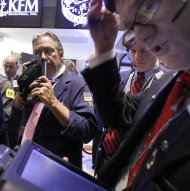
  • FILE - In the June 22, 2011 file photo, traders work on the floor of the New York Stock Exchange. Global stock markets took a battering Monday, July 18, 2011, as investors fled for the security of other assets amid concerns that Europe's debt crisis could engulf larger economies and ahead of another round of discussions over the U.S. debt ceiling.(AP Photo/Richard Drew, file)
    FILE - In the June 22, 2011 file photo, traders work on the floor of the New York …
 Debt worries continue to hang over the stock market, overshadowing a string of strong earnings reports Monday.


Europe's banking troubles and a debate over lifting the U.S. government's borrowing limit helped drag down markets in the U.S., Asia and Europe Monday.


Traders are keeping watch on negotiations in Washington to raise the U.S. government's debt ceiling. The Treasury Department says the limit must be raised by Aug. 2 or the government risks defaulting on its debt. Rating agencies warned last week that the impasse puts the country's top AAA credit rating grade at risk.
The results of stress tests on European banks released Friday did little to reassure investors. Of the 90 European banks tested for how they would fare in a recession, eight flunked. Another 16 barely passed.
The Dow Jones industrial average fell 97 points, or 0.8 percent, to 12,382 in early trading. The S&P 500 index dropped 8 points, or 0.6 percent, to 1,307. The Nasdaq fell 19 points, or 0.7 percent, to 2,770.
 Gannett Co., oil-field services company Halliburton Co. and discount brokerage Charles Schwab Corp. all reported higher earnings.


Hasbro Inc. fell 3 percent. The toy maker's income fell short of Wall Street's estimates despite stronger sales of Transformers action figures and other products.

It's the start of a crowded week for earnings reports. More than 100 members of the S&P 500 index are set to release second-quarter results, including Apple Inc., Johnson & Johnson and General Electric Co. IBM Corp. reports after the close of trading Monday.

Sunday, 10 July 2011

Obama to lawmakers: Meet every day on debt deal

 
    1. Image: Barack Obama, John Boehner, Nancy Pelosi
      Obama tells lawmakers to meet every day on debt deal


President Barack Obama told top lawmakers on Sunday to be prepared to meet every day this week to hash out a deal to cut the federal budget and raise the debt limit, a Democratic source with knowledge of the talks said.


The Democratic official said that Obama pressed Republicans at a White House meeting Sunday evening to aim for a broad, $4 trillion deficit-reduction package rather than a more modest one.
"If not now, when?" the president asked them when some said it was not the right time to try to craft a far-reaching deal, the official said.
Both sides remained divided over the size and the components of a plan to reduce long term deficits. Saying "we need to" work out an agreement over the next 10 days, the president and lawmakers agreed to meet again Monday.


Obama also sought to use the power of his office to sway public opinion, scheduling a news conference for 11 a.m. ET Monday, his second one in less than two weeks devoted primarily to the debt talks.
But there appeared to be little appetite for such an ambitious plan and the political price it would require to pass in Congress. Instead, House Speaker John Boehner told the group that a smaller package of about $2 trillion to $2.4 trillion was more realistic.
A Democratic official familiar with the session said House Majority Leader Eric Cantor, R-Va., was especially adamant that any deficit reduction package could not contain tax increases and that any new tax revenue would have to be used to pay for other tax benefits.

Obama and the congressional leaders met in the Cabinet Room of the White House for the rare Sunday session. Most appeared in casual Sunday clothes, with open-collared shirts underneath blazers.

For Americas "99ers," jobs crisis is hard to escape


SEWELL, New Jersey


Mary Kay Coyne has just filed what she says is her 1,862nd job application since being thrown out of work three years ago.
She is one of millions of Americans whose unemployment benefits have expired -- after 99 weeks in many states -- as the United States suffers its highest level of long-term unemployment since 1948.
Coyne had to move in with a friend after benefit payments ran out last year. Now she gets by on Medicaid -- U.S. health insurance for the poor -- and food stamps, contributing what little she can to her friend's household costs.


"You're 56-years old and you feel like you are sitting on a big pile of nothing," said Coyne, who spends about four hours a day sending out resumes.
"For the better part of a year, I have something sitting on my chest. It's not a medical condition. It is that pressure of 'Is this going to end, when is this going to end?'"

Unlike in much of Europe, the safety net of the U.S. welfare system times out for the long-term unemployed. The federal government and many states have provided extra help for those caught up in the worst labor market in decades but the U.S. debt crisis rules out further extension of the programs.
Coyne is typical of many middle-class Americans now struggling to get by.

She used to earn $70,000 a year as an administrative assistant until her firm began to downsize and left Coyne among the growing number of Americans struggling to live on unemployment benefits, and eventually on minimal food aid.

Now Washington is considering cuts to social welfare programs to shrink a swelling budget deficit.
It may not only be Americans like Coyne who feel the pain. Some economists say the cuts could make it even harder to shrink long-term unemployment that damages the wider economy by dampening consumer demand and lowering output.

In 2010, an estimated 3.9 million unemployed Americans exhausted unemployment benefits, according to the National Employment Law Project, an advocacy group that campaigns for lower-wage workers.
More than 14 percent of the U.S. unemployed have been out of a job for 99 weeks, or longer.
May saw the second-highest percentage and outright number of Americans out of a job for that period or more since weekly data was first collected in 1967. The highest was in April. Payrolls data for June, due on Friday, is unlikely to show a major change in the labor market after the overall jobless rate rose to 9.1 percent in May, economists say.

Many so-called "99ers" subsist on social services like food stamps and Medicaid, programs now in danger of deep cuts demanded by many Republicans in Congress in exchange for allowing the federal government to go deeper into debt.

"An increase in demand for social services is what you would expect in a downturn of this magnitude and so the fact that they are cutting the social safety net is quite perplexing," said Sylvia Allegretto, a labor economist at the University of California at Berkeley. "We've just never seen (long-term unemployment) at these levels, period."

Forty six percent of those looking for work have been jobless for six months or more and the average length of job searches that eventually result in a hiring has doubled to 10 weeks between 2007 and 2010.

Saturday, 25 June 2011

Egypt says will not need IMF, World Bank funds


<p>File photo of Samir Radwan, minister of finance.</p> Egypt will not borrow from the World Bank and International Monetary Fund after revising its budget and cutting the forecast deficit, even though a loan had been agreed, Finance Minister Samir Radwan said .

The 2011/12 deficit in the first draft budget was forecast at 11 percent of gross domestic product, but was revised to 8.6 percent because of a national dialogue and the ruling army council's concerns about debt levels, the minister told .

"So we do not need to go at this stage to the Bank and the Fund," Radwan said, adding Egypt, which had borrowed from the IMF under ousted president Hosni Mubarak, still had the "best relations" with the two US-based institutions.

Despite the budget revisions, the government said it still expected growth of 3.0-3.5 percent, in line with previous forecasts, which some economists said could prove optimistic.

Egypt this month agreed on a $3-billion (1.9 billion pounds), 12-month standby loan facility from the IMF, which Cairo had said came with more lenient terms than usually associated with such lending.

The IMF and World Bank had been among a range of foreign countries and bodies to offer funds to Egypt to help cover a big budget shortfall after the economy was plunged into turmoil by the mass protests that drove Mubarak from office on February 11.

Egypt's cabinet had approved on June 1 a budget for 2011/12 that increased spending by a quarter to create jobs and help the poor. That was revised in a new draft announced on Wednesday that included raising income tax and reducing fuel subsidies.

Gulf Arab states are among those who offered support.

Radwan said Qatar had provided $500 million for budgetary support in the past week. "That is a gift," he said, when asked if there were any conditions attached to the Qatari cash.

He said Saudi Arabia had earlier offered a similar amount.

The minister said the first draft of the budget, which forecast a deficit of about 170 billion Egyptian pounds, was discussed with activists, writers, the business community, trade unions and non-government organisations.

Wednesday, 15 June 2011

Greeks rage against austerity while EU argues

Demonstrators gesture outside the Parliament during a rally against plans for new austerity measures, in central Athens, Wednesday, June 15, 2011. (AP Photo/Kostas Tsironis)
Demonstrators gesture outside the Parliament during a rally against plans for new austerity measures, in central Athens, Wednesday, June 15, 2011. (AP Photo/Kostas Tsironis) Striking Greeks raged against a new wave of austerity on Wednesday after euro zone finance ministers failed to agree how to make private creditors contribute to a second bailout for their indebted country.


As workers staged a national strike, thousands of protesters -- some chanting "Thieves, traitors! Where did the money go" -- massed at parliament to try to prevent lawmakers enacting more tax hikes, spending cuts and sell-offs of state property.


Socialist Prime Minister George Papandreou must push through a five-year deficit reduction and privatisation programme to continue receiving aid from the European Union and International Monetary Fund and avoid default after Greece fell behind on its first 110 billion euros (97.0 billion pounds) rescue plan.


In Brussels, finance ministers of the 17-nation single currency area debated late into the night how to make private bondholders share the cost of the second rescue in two years without triggering even worse turmoil in financial markets.


They are aiming for a deal at a European Union summit on June 23-24 and will meet again on Sunday evening in Luxembourg. However Tuesday's apparent impasse, and the absence of the usual news conference, sent the cost of insuring Greek debt against default rocketing to an all-time high.


Highlighting contagion risks from the Greek crisis, shares in top French banks tumbled after credit ratings agency Moody's said it might downgrade them because of their exposure to Greece's debt-stricken economy.


Greek bank stocks also fell by as much as 7 percent on growing political uncertainty.


The French government sought to deflect market pressure by noting -- perhaps pointedly in the light of differences between Paris and Berlin over the Greek bailout -- that German banks were actually more exposed.


"French banks are exposed to Greece... (but) they are less exposed than the German banking sector, for instance," Secretary of State for European Affairs Laurent Wauquiez said.

Sunday, 12 June 2011

Eurogroup chief backs ‘soft’ Greek debt restructure

Eurogroup head Jean-Claude Juncker backed on Saturday a ‘soft restructuring’ of Greece’s debt with a voluntary contribution from private-sector creditors, as Germany wants.


‘There will be no total restructuring,’ he told a German radio station. ‘The governments are agreed on that, ECB support for such an option could not be obtained.’

‘There must be a soft and voluntary restructuring,’ Juncker added.

Twitter Delicious Facebook Digg Stumbleupon Favorites More